No products in the cart.

As we enter 2026, the lithium iron phosphate (LiFePO4) battery market is undergoing the most profound structural transformation since the birth of the lithium-ion battery industry. For RV enthusiasts, off-grid sailors, and home energy storage enthusiasts in Europe and the United States, a key question remains unresolved: In 2026, is it really still more cost-effective to assemble a battery pack yourself (DIY) than to purchase a ready-made unit from a well-known brand?
This article will break down all the details behind this decision by combining the latest international market data, changes in the raw materials supply chain, and mandatory industry safety standards (UL 9540).

Ⅰ:The 2026 Market Landscape: Cooling Prices and Policy Benefits
1:Cell Prices Enter a Period of “Structural Reshaping”
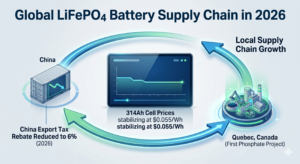
According to Benchmark Mineral Intelligence’s latest April 2026 briefing, the global price of 314Ah high-capacity battery cells has stabilized at around $0.055/Wh (approximately 0.4 RMB/Wh). Although raw material costs for battery cells are at historic lows, end-user prices for finished batteries have not “plummeted by half” as expected due to rising global energy prices and fluctuating logistics costs.
2:The Far-Reaching Impact of China’s Export Tax Rebate Policy
A significant development not to be overlooked is that China’s Ministry of Finance announced that, effective April 2026, the VAT export tax rebate rate for lithium-ion battery products will be reduced from 9% to 6%, with plans to eliminate it entirely by 2027.
This means that the prices of “low-cost Chinese direct-ship batteries,” which previously relied on tax rebate benefits to maintain ultra-low prices, will rise by 3%–5%.
At the same time, local supply chains in North America—such as First Phosphate’s phosphate mining project in Quebec, Canada—have entered the production phase, and locally assembled batteries are beginning to gain a competitive edge in terms of taxes and shipping costs.
3:DIY vs. Pre-built Batteries (2026 Simulation Case Study)
We will conduct a financial comparison using a typical 12V 314Ah (4000Wh) system common the United States as an example:
Option A: DIY Assembly (using Grade A 314Ah cells)
4 cells: $320 (including shipping and customs clearance)
Smart BMS (CAN/RS485 compatible): $120
Accessories (busbars, insulation, enclosure, crimping tools): $100
Total Cost: Approx. $420-$580
Cost per Wh: ~$0.105/Wh
Option B: Value-for-Money Branded Ready-Made Batteries (e.g., LiTime, SOK, buknuwo)
Retail Price: Approx. $430 – $800
Cost per Wh: ~$0.15 – $0.18/Wh
Option C: High-End Industrial-Grade Brands (e.g., Battle Born, Victron)
Retail Price: $1,800+
Cost per Wh: ~$0.35/Wh or higher
Operational Analysis: By 2026, the direct economic advantage of DIY has shrunk to around 25%. Compared to the price difference of over 50% in 2022, DIY is now driven more by “customization needs” rather than simply “saving money.”

4: New Variables in 2026: UL 9540 and Insurance Compliance
This is the most critical “hidden cost” that operators of independent e-commerce sites in Europe and the U.S. must disclose to customers.
- Mandatory UL 9540 Certification
Since the release of the sixth edition of the UL 9540A standard on March 13, 2026, local fire codes in the U.S. and Canada (NFPA 855) have imposed increasingly stringent requirements on residential energy storage systems.
Risk of Insurance Denial: Many major U.S. insurance companies (such as State Farm and Allstate) now explicitly stipulate that if a fire is caused by a battery system that has not passed UL 9540 whole-system certification, the insurer reserves the right to deny coverage.
Limitations of DIY: It is virtually impossible for individually assembled battery packs to obtain whole-system certification, exposing DIY enthusiasts to significant legal and property risks in urban residential applications.
- Special Requirements for RVs and Boats
In mobile applications, the ABYC (American Boat and Yacht Council) updated its installation standards for lithium-ion batteries in 2026. The standards require batteries to be capable of communicating with the vessel’s energy management system (NMEA 2000 protocol). The time cost for DIY enthusiasts to debug communication protocols often exceeds the few hundred dollars saved.
5:Expert Recommendations for Key Scenarios
- Home Off-Grid Solar Systems
Recommendation: Purchase UL-certified server rack batteries.
Reason: Safety and compliance are paramount. Server rack batteries feature a stable structure and can communicate directly with mainstream inverters (such as Pylontech and Schneider), increasing installation efficiency by 80%.
- RVs and Vans (RV & Van Life)
Recommendation:Purchase pre-assembled batteries with low-temperature protection.
Reason:DIY enthusiasts typically purchase third-party BMS units. Although most claim to have low-temperature protection, in actual testing, errors from low-cost sensors can reach as high as ±5°C. In pre-made battery packs, sensors are embedded at the center of the cell stack, whereas in DIY setups they are often simply attached to the surface; such measurement errors can be fatal in winter.
- Marine/Boating Applications
Recommendation: Purchase sealed, off-the-shelf batteries with an IP67 protection rating.
Reason: Salt spray corrosion is the biggest threat to DIY batteries. Sealed, brand-name batteries far outperform simple, hand-assembled enclosures in terms of shock resistance and corrosion resistance.
6:How to Choose in 2026?
Reasons to Choose DIY:
You enjoy the assembly process and are a seasoned electronics engineer.
You require an extremely specialized battery shape (e.g., ultra-thin or extra-long).
Your application is “completely off-grid in the wilderness” and does not involve home insurance compliance issues.
Reasons to Choose a Ready-Made Solution:
Time Value: The cost of a modern person’s time far exceeds the $200 price difference.
Warranty Commitment: Leading brands in 2026 offer extended warranties of 5 years or more, providing risk mitigation that DIY solutions cannot match.
Legal Compliance: UL certification is essential for property appreciation and insurance coverage.