No products in the cart.
In today’s tech media and capital markets, “solid-state batteries” remain a focal topic, with their core value lying in the potential to break through the performance bottlenecks of traditional liquid lithium-ion batteries, achieving higher energy density and better safety. However, when we shift our focus from Nasdaq press conferences to the paralyzed power substations in Texas during extreme cold, or the communities in California facing rolling blackouts amid midsummer heatwaves, a crucial reality emerges: solid-state batteries are still far from commercial application and cannot meet the urgent needs of current home energy storage.
In 2026, the U.S. home energy storage market has not seen the large-scale rollout of solid-state batteries. On the contrary, the lithium iron phosphate (LFP) system, once regarded as “low-tech,” has fully covered various scenarios such as RV off-grid power supply and home backup power, achieving market dominance. Leading industry players like Tesla and Enphase have successively adjusted their technical routes to focus on LFP; numerous U.S. households have built LFP-based energy storage systems in their garages and basements, forming “microgrids.” LFP’s dominant market position is no accident—it is the inevitable result of the interaction between technological maturity, climate-related demand, and market economic laws.
- 1. Dispelling Misconceptions: The Difference in Battery Requirements Between Home Energy Storage and Electric Vehicles
To understand LFP’s dominant market position, the primary prerequisite is to distinguish the core demand differences between electric vehicles (EVs) and home energy storage systems (ESS), avoiding the blind application of battery standards from one to the other.
Solid-state batteries are highly anticipated by the industry primarily because they aim to break the “impossible trinity” of traditional liquid lithium-ion batteries—energy density, safety, and cost—while ensuring safety, significantly increasing energy density. For electric vehicles, with limited chassis space, the weight and volume of the battery directly determine the driving range, and alleviating range anxiety is a core competitive advantage for enterprises. Therefore, research and development on solid-state batteries focus on core technical challenges such as solid-solid interface contact and solid electrolyte conductivity. However, high R&D investment and unresolved yield bottlenecks mean that solid-state batteries can only be applied to high-end models in the short term, making large-scale, low-cost popularization impossible.
The demand logic for home energy storage systems is completely different from that of electric vehicles. Energy storage equipment is mostly installed in fixed spaces such as garage walls and basement cabinets, where weight and volume are not core considerations—even if an energy storage cabinet weighs hundreds of pounds, as long as it is firmly fixed, the slight difference in space it occupies will not affect actual use.
The core demands of U.S. home energy storage focus on another “impossible trinity”: extreme safety, ultra-long cycle life, and extremely low levelized cost of energy (LCOE). From the current technical level, solid-state batteries have not met practical standards in these three dimensions, while LFP has formed significant advantages. By 2026, the LFP industrial chain has become highly mature, and manufacturing costs have been compressed to the industry’s low end. Unlike nickel-manganese-cobalt (NMC) lithium batteries, LFP does not rely on scarce precious metals such as cobalt and nickel, which are highly affected by geopolitics. Its core raw materials are iron and phosphorus, which are abundant and low-cost. This inherent advantage allows LFP to achieve large-scale popularization in the home energy storage market at a price that solid-state batteries cannot match.
- 2. Safety Bottom Line and Technological Upgrades: LFP Restructures the Core Value of Home Energy Storage
With the increasing frequency of extreme weather in the U.S., home energy storage systems have evolved from “optimized consumption” to “survival-level rigid demand.” Large-scale power outages caused by winter storms in Texas and Public Safety Power Shutoffs (PSPS) in California due to extreme high temperatures and wildfires have exposed the fragility of the power grid, driving U.S. households to accelerate the construction of independent “home power shelters”—and safety has become a core veto factor for home energy storage systems.
In the past, fire accidents caused by thermal runaway of traditional NMC lithium batteries have significantly affected household acceptance of energy storage systems. The thermal runaway threshold of NMC lithium batteries is approximately 150°C; when this temperature is reached, the cathode material is prone to decomposition and releases oxygen. Once thermal runaway occurs, oxygen intensifies combustion, which is difficult to completely extinguish with conventional fire extinguishers, posing significant safety hazards.
LFP has an extremely stable chemical structure, with strong covalent bonds between phosphorus and oxygen (P-O) in its cathode material, giving it a thermal runaway threshold of over 270°C. More importantly, even in extreme damage scenarios such as puncture and high temperature, LFP materials do not release oxygen, fundamentally eliminating the risk of combustion. It is suitable for enclosed installation environments such as garages and basements, eliminating household safety concerns.
By 2026, LFP technology has completed upgrades and iterations in cell capacity and system integration, with the industry shifting from traditional small-capacity (hundreds of ampere-hours) cells to large-capacity cells. Taking buknuwo, a mainstream energy storage brand, as an example, its core product line has widely adopted high-capacity 12.8V 314Ah lithium iron phosphate cells. This technological upgrade has completely optimized the assembly logic of home and off-grid energy storage systems.
Under the traditional technical route, building a large-scale home backup power system required complex series-parallel combinations of dozens or even hundreds of small-capacity cells. The more series-parallel nodes, the more obvious the “barrel effect,” the greater the balancing pressure on the Battery Management System (BMS), and the higher the system failure rate. With 314Ah large-capacity single cells, building a home energy storage system of over 15kWh only requires a small number of physical connections. Fewer nodes not only reduce system internal resistance and heat generation but also exponentially improve system reliability.
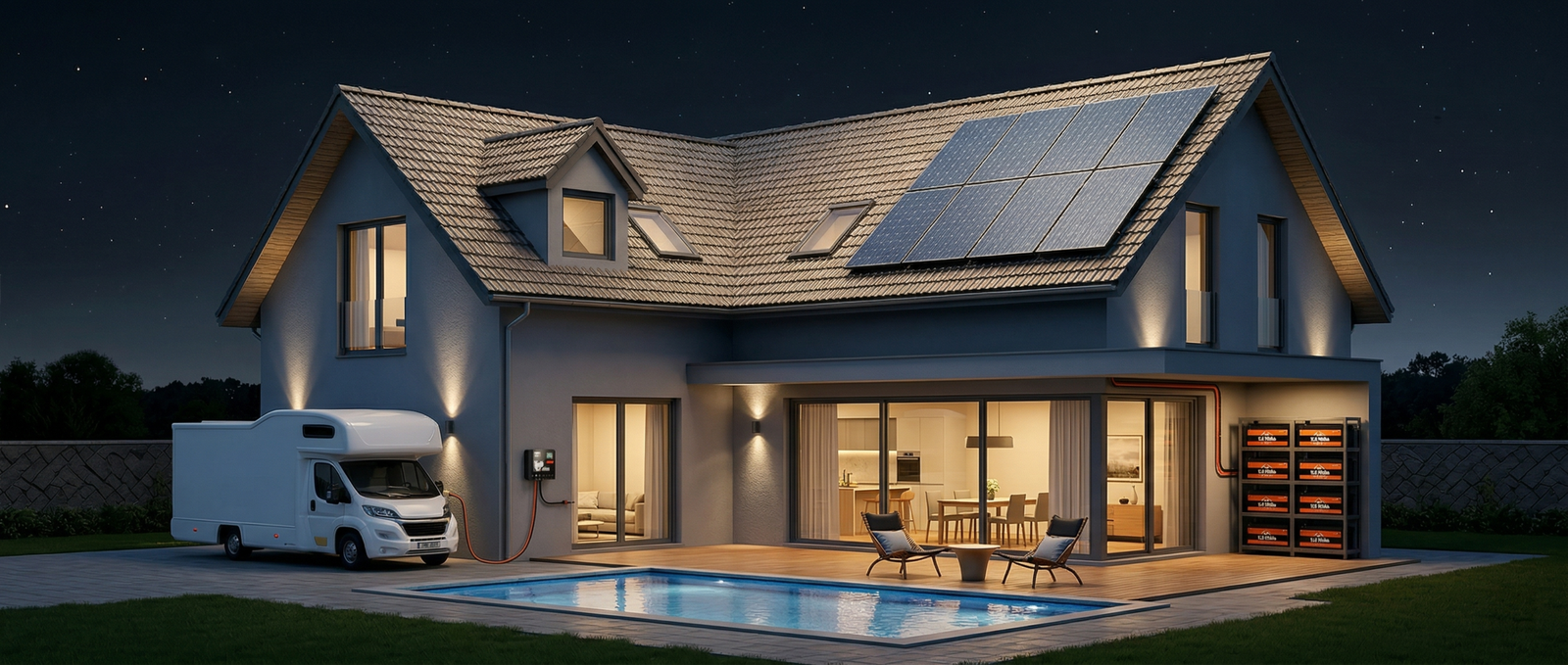
In addition, the ecological compatibility of high-specification LFP systems has reached industrial-grade standards. Whether in self-built ranches in Texas or RV off-grid scenarios in California, 12.8V 314Ah battery packs can seamlessly adapt to top-tier solar charge controllers such as Victron MPPT. Victron MPPT’s precise charging algorithm maximizes the power generation efficiency of solar panels and safely stores electrical energy with a charging curve suitable for LFP cells. The combination of “high-capacity LFP cells + professional MPPT controller + intelligent BMS” has brought the stability of home energy storage systems to an industrial level, capable of providing stable power supply for days or even weeks when the power grid fails.
- 3. Policy Drivers and Economic Benefits: The Core Impetus for LFP to Become the Sole Market Choice
Driven by rigid demand from extreme weather, coupled with U.S. energy policy guidance and high electricity prices, LFP’s dominant position in the U.S. home energy storage market has been accelerated. In 2026, installing an LFP energy storage system has transformed from a purely “defensive expenditure” to an “operational investment” with clear returns.
The Net Energy Metering (NEM) 3.0 policy implemented in California has had a decisive impact on the home energy storage market. Before NEM 3.0, households with rooftop solar could feed excess daytime electricity into the grid at full price and purchase electricity from the grid at the same price at night, effectively using the grid as a free, unlimited-capacity energy storage device. However, NEM 3.0 drastically adjusted feed-in tariffs, reducing the revenue from daytime grid feed-in by as much as 75%. Without an energy storage system, most of the electricity generated by rooftop solar cannot be effectively utilized, significantly reducing the economics of the solar system.
The popularization of LFP energy storage systems has completely changed the revenue logic of solar systems. The cycle life of LFP cells can reach more than 4,000 to 6,000 cycles—calculated at one charge-discharge cycle per day, the service life can reach 12 to 15 years, which can long-term support “peak shaving” operations. During the day, the Victron MPPT controller stores solar power in LFP battery packs such as buknuwo; during the peak electricity price period from 4 PM to 9 PM, the system automatically switches to energy storage power supply mode, cutting off the high-cost connection to the grid. In states with high tiered electricity prices, this daily operation can save households hundreds of dollars in electricity bills per month, significantly improving the return on investment (ROI) of solar + energy storage systems.
The Inflation Reduction Act (IRA) launched by the U.S. federal government has further lowered the installation threshold for LFP energy storage systems. The 30% federal Investment Tax Credit (ITC) provided by the act directly reduces the initial investment for household users; moreover, the service life of LFP systems far exceeds the investment payback period, transforming them from “consumables” into assets that can continuously generate cash flow. Even if solid-state batteries are mass-produced in the next few years, their high manufacturing costs and premiums will make it impossible for them to compete in the home energy storage market, which values ROI and technological maturity.
In the process of technological progress, what truly drives social change is often not the most cutting-edge technology in the laboratory, but mature solutions that achieve the optimal balance between cost, safety, and practicality. Solid-state batteries are undoubtedly the future direction of the electric vehicle industry, and their technological breakthroughs will completely solve the problem of range anxiety. However, in 2026, facing real challenges such as extreme high temperatures and power grid failures, household users need reliable solutions that can be put into use immediately to ensure power supply.
With its non-combustible safety bottom line, ultra-long cycle life, and efficient compatibility with solar systems, lithium iron phosphate (LFP) has achieved full dominance in the U.S. home energy storage market, becoming an undisputed industry standard. With its mature technology and low cost, it has built a reliable power protection line for U.S. households in an era of increasing climate uncertainty. This is not only a market victory for LFP technology but also an inevitable result of humanity’s adherence to a pragmatic orientation in the pursuit of energy independence.